Shortlist
Suricata, Snort and Zeek are the core of this shortlist: the first two document intrusion detection and prevention directly, and Zeek adds network visibility. It is written for small IT teams, homelab operators and budget-constrained security teams that want to detect and block network threats with open-source software. OPNsense, pfSense and Security Onion follow as platforms that bundle or build on these engines.
On this page 7 sections · 6 tools
Who should pick what
- Suricata if you need teams that want a dedicated detection and inline prevention engine.
- Snort if you need home networks and small organizations that want rule-based detection and prevention.
- Zeek if you need teams that need detailed traffic logs for investigation, with a SIEM or manual review.
- OPNsense if you need small networks that want a firewall with built-in intrusion prevention.
- pfSense if you need teams that want a web-managed firewall they can extend with packages.
- Security Onion if you need teams building a security monitoring setup with hunting and case management.
Comparison table
 Suricata |  Snort |  Zeek |  OPNsense | |
|---|---|---|---|---|
| Who it is for | Teams that want a dedicated detection and inline prevention engine | Home networks and small organizations that want rule-based detection and prevention | Teams that need detailed traffic logs for investigation, with a SIEM or manual review | Small networks that want a firewall with built-in intrusion prevention |
| Platforms | Linux and Windows (IPS guides); Docker and Podman containers | Linux and Windows | Hardware, software, virtual or cloud-based sensor | Based on FreeBSD; official hardware appliances are sold |
| Documented strengths | Guides for IPS/inline mode on Linux and on Windows | Lightweight NIDS for Linux and Windows | Deep inspection of application-layer protocols such as HTTP, DNS, SSL/TLS and SSH | Inline intrusion prevention using Suricata with Emerging Threats Open rules |
| Pricing | Pricing on suricata.io | Pricing on snort.org | Pricing on zeek.org | Pricing on opnsense.org |
Table shows the first 4 picks; all 6 are summarised below.
- SuricataTeams that want a dedicated detection and inline prevention engine
- SnortHome networks and small organizations that want rule-based detection and prevention
- ZeekTeams that need detailed traffic logs for investigation, with a SIEM or manual review
- OPNsenseSmall networks that want a firewall with built-in intrusion prevention
 pfSenseTeams that want a web-managed firewall they can extend with packages
 Security OnionTeams building a security monitoring setup with hunting and case management
Entry details
#1 · Open Information Security Foundation
Suricata
Teams that want a dedicated detection and inline prevention engine

Suricata is a security tool that processes untrusted network data. It has IPS/inline modes and a firewall mode, and is documented by the Open Information Security Foundation.
Documented strengths
- Guides for IPS/inline mode on Linux and on Windows
- Can drop to a non-root user after startup (Linux only)
- suricata-update and suricatasc can run without root once permissions are set
- Docker and Podman containers can isolate it from the host
- RPMs from the OISF COPR and EPEL repos come with non-root setup configured
Documented limits
It needs elevated privileges to read traffic, and it does not work with rootless Podman. Its documentation also warns that supply chain attacks around rule distribution could target installations.
- Who it is for
- Teams that want a dedicated detection and inline prevention engine
- Platforms
- Linux and Windows (IPS guides); Docker and Podman containers
- Pricing
- See the vendor's own pricing page for current plans and costs. suricata.io
- Date checked
- 21 November 2026
Why it is placed here: It sits first because its documentation covers inline IPS setup on both Linux and Windows, which is the most direct path to blocking traffic in this list.
#2 · Cisco Talos
Snort
Home networks and small organizations that want rule-based detection and prevention

Snort is an open-source network intrusion detection and prevention system that uses rules to detect malicious network activity. Its rulesets are developed by Cisco Talos.
Documented strengths
- Lightweight NIDS for Linux and Windows
- Rule matching against packets, with alerts on malicious activity
- Inline deployment to stop malicious packets
- Packet sniffer, packet logger or full network intrusion prevention modes
- Community Ruleset quality-checked by Cisco Talos
Documented limits
The Snort Subscriber Ruleset is developed by Cisco Talos, and the Community Ruleset is a separate set. Teams should check the vendor documentation for how the two differ.
- Who it is for
- Home networks and small organizations that want rule-based detection and prevention
- Platforms
- Linux and Windows
- Pricing
- See the vendor's own pricing page for current plans and costs. snort.org
- Date checked
- 21 November 2026
Why it is placed here: It follows Suricata because it also delivers detection and inline prevention directly, with documented setup guides and community-quality-checked rules.
#3 · Zeek Project
Zeek
Teams that need detailed traffic logs for investigation, with a SIEM or manual review
zeek.orgZeek is an open-source, scriptable network security monitor that passively analyzes traffic. It produces structured logs for analysts and SIEMs.
Documented strengths
- Deep inspection of application-layer protocols such as HTTP, DNS, SSL/TLS and SSH
- Transaction logs, file contents and customizable outputs
- Its own scripting language, plus community-contributed scripts and packages
- Runs on a sensor that can be hardware, software, virtual or cloud-based
- BSD license
Documented limits
Zeek is not an active defense tool like a firewall or IPS, so teams that need blocking should pair it with another tool.
- Who it is for
- Teams that need detailed traffic logs for investigation, with a SIEM or manual review
- Platforms
- Hardware, software, virtual or cloud-based sensor
- Pricing
- See the vendor's own pricing page for current plans and costs. zeek.org
- Date checked
- 21 November 2026
Why it is placed here: It sits third because it adds deep protocol visibility rather than blocking, which makes it a strong complement to an IDS or IPS engine.
#4 · Deciso
OPNsense
Small networks that want a firewall with built-in intrusion prevention
OPNsense is an open source firewall and routing platform from Deciso. It includes inline intrusion prevention and VPN support.
Documented strengths
- Inline intrusion prevention using Suricata with Emerging Threats Open rules
- Stateful firewall for IPv4 and IPv6 with a live view of blocked or passed traffic
- IPsec and OpenVPN natively, with pluggable Tinc and WireGuard support
- NetFlow analysis and RRD graphs with data export
- Q-Feeds threat intelligence integration
Documented limits
It is a firewall platform first, so teams that want only passive monitoring may need less than it provides. A separate paid Business Edition exists for turnkey needs; see the vendor site for details.
- Who it is for
- Small networks that want a firewall with built-in intrusion prevention
- Platforms
- Based on FreeBSD; official hardware appliances are sold
- Pricing
- See the vendor's own pricing page for current plans and costs. opnsense.org
- Date checked
- 21 November 2026
Why it is placed here: It sits fourth because inline prevention arrives as part of a full firewall, using Suricata with Emerging Threats Open rules, so one system covers perimeter and intrusion prevention.
#5 · Netgate
pfSense
Teams that want a web-managed firewall they can extend with packages
pfSense is a free, open source firewall and router distribution based on FreeBSD that also offers unified threat management, load balancing and multi-WAN.
Documented strengths
- Customized FreeBSD distribution managed entirely through a web interface
- Package system for expansion, including Snort and ntop
- UTM, load balancing and multi-WAN
- Source code under the Apache 2.0 license
- Commercial support and official training available from Netgate
Documented limits
Snort and ntop packages need at least 1GB RAM, and VPN use increases CPU requirements. Hardware compatibility matches FreeBSD's.
- Who it is for
- Teams that want a web-managed firewall they can extend with packages
- Platforms
- FreeBSD-based; Netgate virtual appliances with pfSense Plus run on AWS and Azure
- Pricing
- See the vendor's own pricing page for current plans and costs. pfsense.org
- Date checked
- 21 November 2026
Why it is placed here: It sits fifth because intrusion detection is added through the Snort package rather than built into the base firewall.
#6 · Security Onion Solutions
Security Onion
Teams building a security monitoring setup with hunting and case management
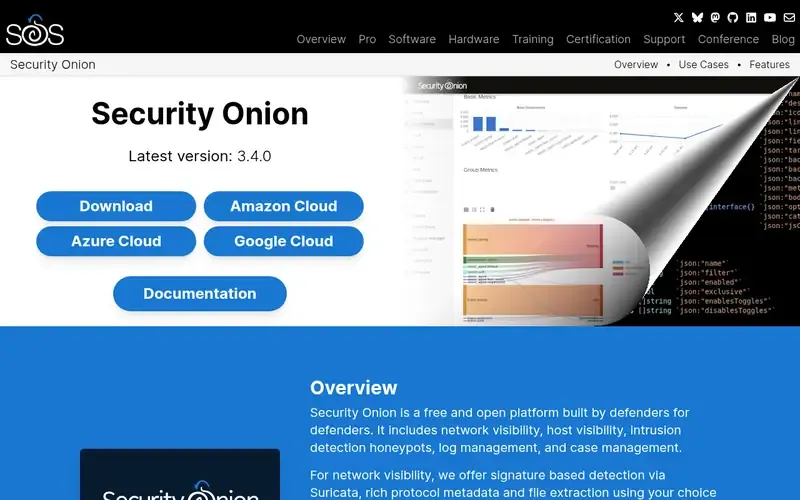
Security Onion is a free and open platform for network and host visibility, intrusion detection, log management and case management.
Documented strengths
- Network visibility using Suricata, Zeek, full packet capture and Strelka file analysis
- Host visibility with Elastic Agent, osquery live queries and Elastic Fleet
- Logs flow into the Elastic stack, with interfaces for alerting, hunting, dashboards and cases
- Setup wizard that builds a distributed grid
- Scales from a single appliance to a grid of a thousand nodes
Documented limits
Documented as a platform built for defenders and SOC analysts. Very small teams should check the vendor documentation for the resources a deployment needs.
- Who it is for
- Teams building a security monitoring setup with hunting and case management
- Platforms
- Single appliance or distributed grid; Linux desktop install option for SOC analysts
- Pricing
- See the vendor's own pricing page for current plans and costs. securityonionsolutions.com
- Date checked
- 21 November 2026
Why it is placed here: It sits last because it is the broadest option, bundling Suricata, Zeek and the Elastic stack, which suits teams ready for a full monitoring grid rather than a single sensor.
Sources
- Suricata: suricata.io, docs.suricata.io/en/suricata-8.0.8, docs.suricata.io/en/suricata-8.0.8/security.html (21 Nov 2026)
- Snort: snort.org, snort.org/products (21 Nov 2026)
- Zeek: zeek.org, zeek.org/about, zeek.org/security-reporting (21 Nov 2026)
- OPNsense: opnsense.org, opnsense.org/features (21 Nov 2026)
- pfSense: pfsense.org, pfsense.org/products, pfsense.org/about-pfsense (21 Nov 2026)
- Security Onion: securityonionsolutions.com/software (21 Nov 2026)
Common questions
What is the difference between an IDS and an IPS?
An IDS detects and alerts on suspicious traffic, while an IPS can also block it inline. Snort is documented for both, and Suricata documents IPS/inline mode. Zeek is not an active defense tool like a firewall or IPS.
Should I choose Suricata or Snort?
Both document intrusion detection and inline prevention. Suricata's guides cover IPS mode on Linux and Windows. Snort documents Linux and Windows support, with Cisco Talos rulesets and a community ruleset.
Can I run intrusion prevention inside a firewall?
Yes. OPNsense includes inline intrusion prevention using Suricata with Emerging Threats Open rules. pfSense offers Snort as a package, which needs at least 1GB RAM.
Does Zeek block attacks?
No. Zeek is not an active defense tool like a firewall or IPS. It analyzes traffic and produces structured logs suited to forensics, compliance and SIEM integration.
Is there an open-source platform that combines several of these tools?
Security Onion bundles Suricata, Zeek, full packet capture and Strelka file analysis, with logs flowing into the Elastic stack. It scales from a single appliance to a grid of a thousand nodes.
Related guides
Method
We ordered the tools by how directly each delivers intrusion detection or prevention out of the box, then by the breadth of added network visibility. We also weighed documented capabilities, and the platform and deployment details each project publishes. Tools whose documentation centers on detection and prevention sit first. Tools that bundle detection with firewalling, logging or case management follow.
Every fact comes from official project or vendor pages, and we record the date each page was checked. The order reflects editorial fit for this use case, and each entry explains its position in words. The list is built from documentation rather than product trials, so entries describe what projects state, not how they perform on a given network. Some tools also have commercial offerings, which this shortlist does not cover.
Order used: Ordered by how directly each tool delivers intrusion detection or prevention out of the box, then by breadth of added network visibility.
Editorial order cannot be bought. A vendor may purchase one labelled featured slot per guide, and that entry gets the same fact check as every other. There are no affiliate links today. Datahurst is independent. Product names and trademarks belong to their respective owners.