Shortlist
Ramp, Brex and Spendesk lead this shortlist because each documents corporate cards, spend controls and accounting sync in one product. It is written for startups and fast-growing small businesses that want to issue company cards, set budgets and stop chasing receipts. The remaining four tools cover regional, multi-entity and receipt-first needs.
On this page 7 sections · 7 tools
Who should pick what
- Ramp if you need startups that want cards, policy rules and accounting automation in one place.
- Brex if you need startups and founders that want cards and banking together, with API access.
- Spendesk if you need growing European companies of roughly 50 to 250 employees.
- Payhawk if you need multi-entity startups that need group-level controls.
- Divvy if you need small businesses already using, or considering, the wider BILL platform.
- Pleo if you need european growing businesses that want cards with automated VAT handling.
Comparison table
 Ramp |  Brex |  Spendesk |  Payhawk | |
|---|---|---|---|---|
| Who it is for | Startups that want cards, policy rules and accounting automation in one place | Startups and founders that want cards and banking together, with API access | Growing European companies of roughly 50 to 250 employees | Multi-entity startups that need group-level controls |
| Platforms | Not stated on official pages | Not stated on official pages | Not stated on official pages | Hosted on AWS infrastructure and Google Cloud Platform |
| Documented strengths | Cards, permissions and limits provisioned by role, location, department and custom fields | Budgets and spend limits enforced automatically | Cards, expenses, AP, procurement and budgets in a single system | Cards with granular limits and pre-emptive blocking at the point of transaction |
| Pricing | Pricing on ramp.com | Pricing on brex.com | Pricing on spendesk.com | Pricing on payhawk.com |
Table shows the first 4 picks; all 7 are summarised below.
- RampStartups that want cards, policy rules and accounting automation in one place
- BrexStartups and founders that want cards and banking together, with API access
- SpendeskGrowing European companies of roughly 50 to 250 employees
- PayhawkMulti-entity startups that need group-level controls
 DivvySmall businesses already using, or considering, the wider BILL platform
 PleoEuropean growing businesses that want cards with automated VAT handling
 ExpensifyTeams that put receipt capture and reimbursement first
Entry details
#1 · Ramp
Ramp
Startups that want cards, policy rules and accounting automation in one place
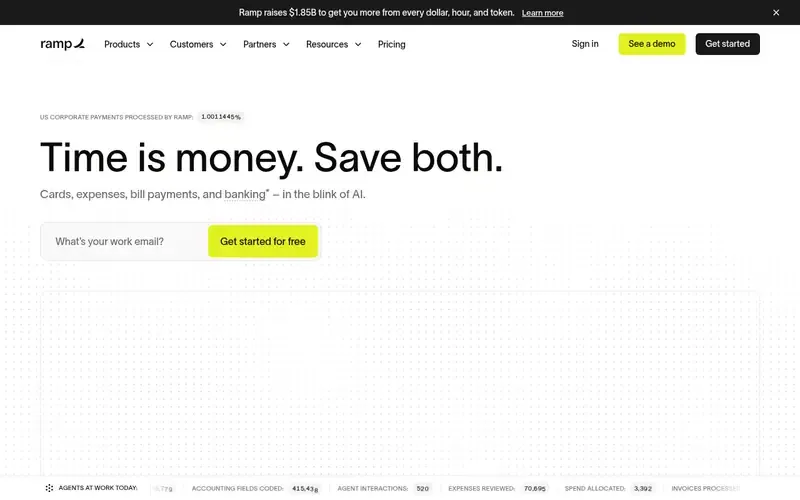
Ramp is a spend management platform that combines corporate cards, expenses, travel, accounts payable and accounting automation. It aims to automate finance operations.
Documented strengths
- Cards, permissions and limits provisioned by role, location, department and custom fields
- Single-use or recurring virtual cards with spend limits and vendor restrictions
- Receipts captured and matched to transactions automatically
- Flags expenses that violate custom policies
- More than 200 integrations, with ERP sync that supports multiple entities
Documented limits
Ramp states its audience as finance teams, accountants and enterprises. Early-stage teams should check the vendor documentation for how its feature set maps to a small setup.
- Who it is for
- Startups that want cards, policy rules and accounting automation in one place
- Platforms
- Not stated on official pages
- Pricing
- See the vendor's own pricing page for current plans and costs. ramp.com
- Date checked
- 21 November 2026
Why it is placed here: It sits first because its documentation pairs role-based card provisioning, virtual cards with limits, automatic receipt matching and ERP sync in a single platform.
#2 · Brex
Brex
Startups and founders that want cards and banking together, with API access
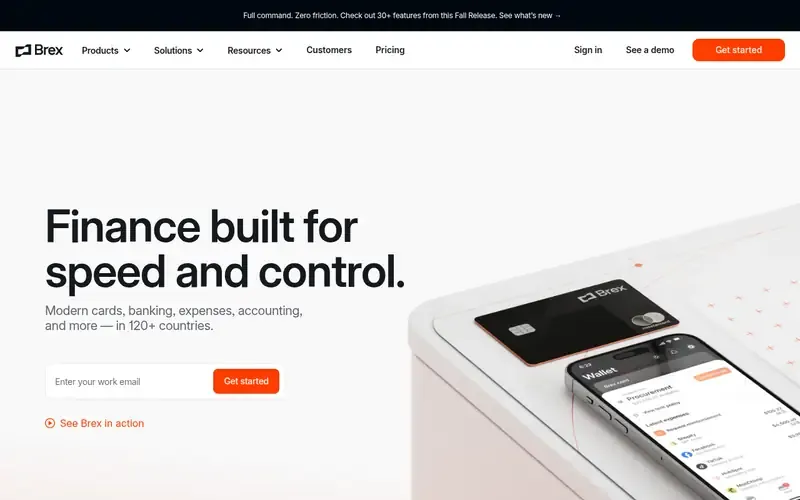
Brex is a finance software platform offering corporate cards, banking, expense management, travel, bill pay and accounting automation.
Documented strengths
- Budgets and spend limits enforced automatically
- Physical and virtual cards issued in 60+ countries
- Budgets and limits managed in over 100 currencies with localized expense policies
- Receipts in any language or currency matched automatically
- Payments, transactions and team APIs for programmatic ACH, wire and check payments, reporting and virtual card issuing
Documented limits
Documented as covering cards, banking, expenses and accounting across 120+ countries. Teams that need specific local accounting setups should confirm ERP support in the vendor documentation.
- Who it is for
- Startups and founders that want cards and banking together, with API access
- Platforms
- Not stated on official pages
- Pricing
- See the vendor's own pricing page for current plans and costs. brex.com
- Date checked
- 21 November 2026
Why it is placed here: It follows Ramp because its documentation names startups directly and combines automatically enforced budgets, card issuing and two-way ERP integrations.
#3 · Spendesk
Spendesk
Growing European companies of roughly 50 to 250 employees
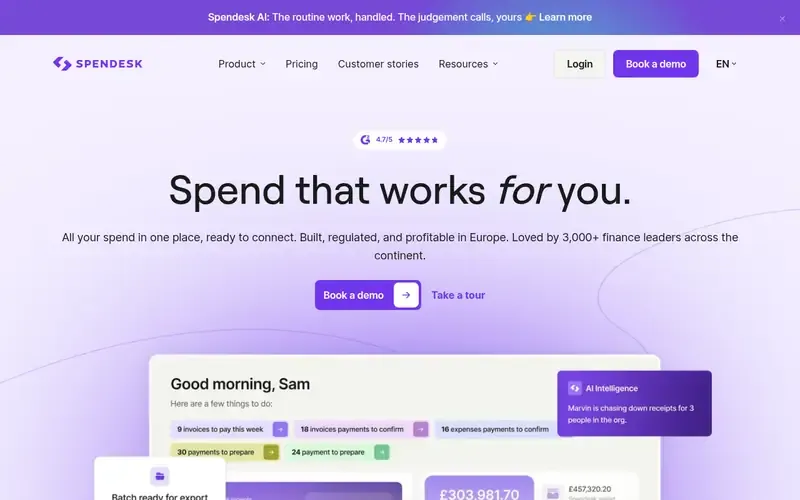
Spendesk is a spend management platform for finance teams that connects corporate cards, expenses, accounts payable, procurement and budgets in one system.
Documented strengths
- Cards, expenses, AP, procurement and budgets in a single system
- Purchase requests connected to budgets, approvals and payment
- Duplicate detection and anomaly flagging
- Automated data capture, transaction matching and accounting push
- ISO 27001:2022 certification and GDPR and PCI-DSS compliance, as stated by the vendor
Documented limits
Aimed at companies of roughly 50 to 250 employees, though other sizes are supported. Very small startups should check the vendor documentation for fit.
- Who it is for
- Growing European companies of roughly 50 to 250 employees
- Platforms
- Not stated on official pages
- Pricing
- See the vendor's own pricing page for current plans and costs. spendesk.com
- Date checked
- 21 November 2026
Why it is placed here: It sits third because its purchase-request workflow ties budgets, approvals and payment together, though its stated audience is mid-sized teams in Europe rather than early-stage startups.
#4 · Payhawk
Payhawk
Multi-entity startups that need group-level controls
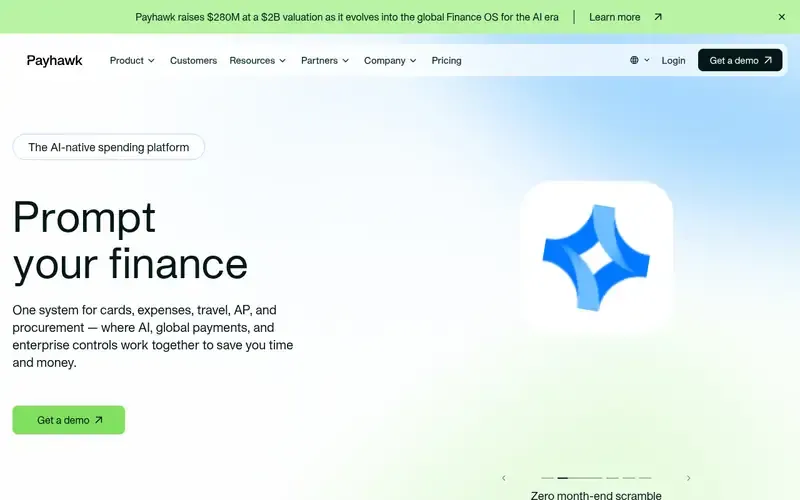
Payhawk is an AI-powered spend management platform combining corporate cards, expenses, accounts payable, procurement and travel with ERP sync.
Documented strengths
- Cards with granular limits and pre-emptive blocking at the point of transaction
- Controls at group or entity level with real-time visibility
- Financial Controller Agent for receipt collection, document matching and transaction coding
- Native two-way sync with ERP and HR systems, including SAP S/4HANA, NetSuite, Dynamics and Sage
- Payments in 115 currencies across 150+ countries
Documented limits
Payhawk lists finance teams, multi-entity businesses and enterprises as its audience. Single-entity startups should check the vendor documentation for how much of the group tooling they need.
- Who it is for
- Multi-entity startups that need group-level controls
- Platforms
- Hosted on AWS infrastructure and Google Cloud Platform
- Pricing
- See the vendor's own pricing page for current plans and costs. payhawk.com
- Date checked
- 21 November 2026
Why it is placed here: It fits fourth for startups with several legal entities, because controls can be set at group or entity level and cards support pre-emptive blocking at the point of transaction.
#5 · BILL
Divvy
Small businesses already using, or considering, the wider BILL platform
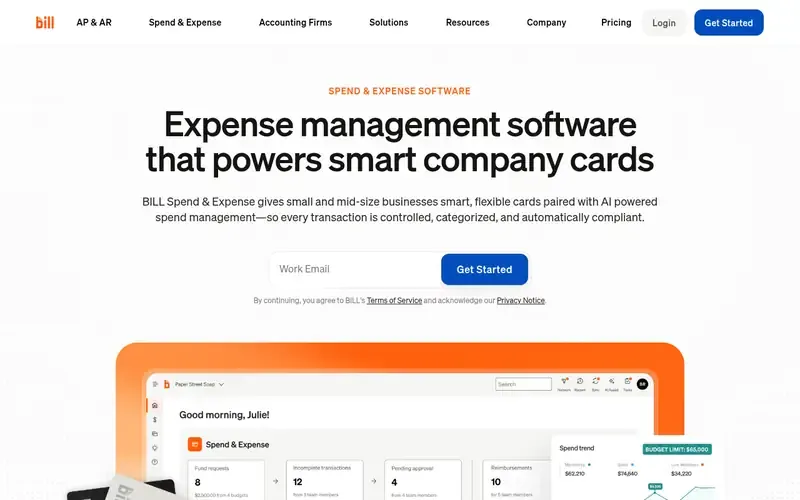
BILL Spend & Expense, formerly Divvy, is expense management software that pairs company cards with AI-powered spend management for small and mid-size businesses.
Documented strengths
- Physical or virtual cards with limits and rules built in
- Receipt capture by photo, with transactions appearing instantly
- AI matches receipts to transactions, codes accounting fields and writes memos
- Scheduled month-end close with automated approval reminders
- Two-way sync with several accounting and ERP systems
Documented limits
The card is issued through bank partners and is not a deposit product. Teams that want banking and cards from one provider should check the vendor documentation.
- Who it is for
- Small businesses already using, or considering, the wider BILL platform
- Platforms
- Mobile experience for receipt capture and card management; other platforms not stated on official pages
- Pricing
- See the vendor's own pricing page for current plans and costs. bill.com
- Date checked
- 21 November 2026
Why it is placed here: It sits fifth because its card and receipt workflow suits small businesses, while the documentation centers on the wider BILL platform of AP, AR and spend under one login.
#6 · Pleo
Pleo
European growing businesses that want cards with automated VAT handling

Pleo is a business spend management platform offering company cards, expense reimbursements and accounts payable automation that syncs to accounting tools.
Documented strengths
- Smart company cards with individual spending limits
- Employee and vendor cards
- Receipts captured with OCR from a photo
- Automatic sync to 100+ accounting and ERP packages
- Approval trails, automated VAT processes and an activity log for audit readiness
Documented limits
Pleo lists finance teams, growing businesses across Europe and enterprise companies as its audience. Startups outside Europe should check the vendor documentation for regional coverage.
- Who it is for
- European growing businesses that want cards with automated VAT handling
- Platforms
- Not stated on official pages
- Pricing
- See the vendor's own pricing page for current plans and costs. pleo.io
- Date checked
- 21 November 2026
Why it is placed here: It sits sixth because its employee and vendor cards with individual limits fit this use case well, but its stated audience leans toward European finance teams and larger companies.
#7 · Expensify
Expensify
Teams that put receipt capture and reimbursement first
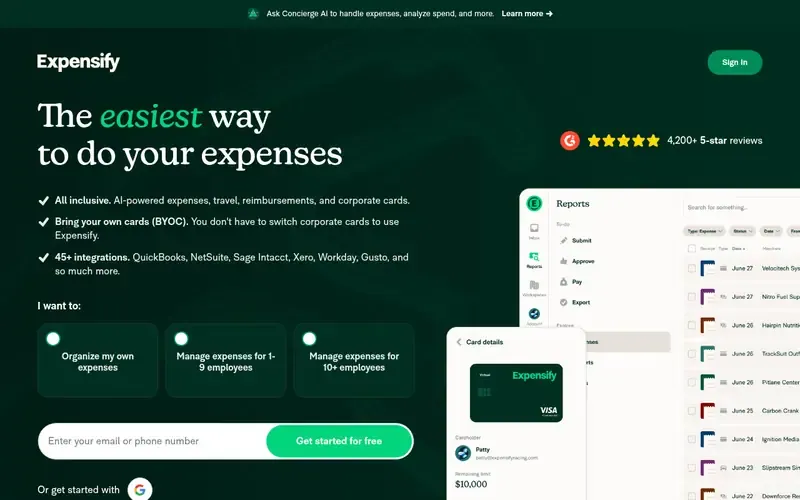
Expensify is an all-in-one expense management platform for tracking receipts, managing expenses and handling reimbursement.
Documented strengths
- Receipts captured by photo, email forwarding, text or file upload
- Bring your own corporate cards for automatic reconciliation
- Unlimited virtual cards for employees, vendors or projects
- Concierge AI categorizes expenses and flags policy violations
- Budgets set and tracked across teams and departments
Documented limits
Documented as an expense and reimbursement platform with 45+ integrations. Startups that want a card program as the core of their spend control should check the vendor documentation.
- Who it is for
- Teams that put receipt capture and reimbursement first
- Platforms
- Mobile app with full functionality for expenses, cards and travel
- Pricing
- See the vendor's own pricing page for current plans and costs. expensify.com
- Date checked
- 21 November 2026
Why it is placed here: It sits last for this use case because it is organized around receipts and reimbursement, and its card option centers on bringing your own corporate cards as well as virtual cards.
Sources
- Ramp: ramp.com, ramp.com/about-us, ramp.com/platform (21 Nov 2026)
- Brex: brex.com, brex.com/about, brex.com/product/api (21 Nov 2026)
- Spendesk: spendesk.com, spendesk.com/about, spendesk.com/platform/mcp (21 Nov 2026)
- Payhawk: payhawk.com, payhawk.com/about, payhawk.com/security (21 Nov 2026)
- Divvy: bill.com/product/spend-and-expense, bill.com/product (21 Nov 2026)
- Pleo: pleo.io/en, pleo.io/en/about, pleo.io/en/features (21 Nov 2026)
- Expensify: expensify.com (21 Nov 2026)
Common questions
What is the difference between expense management and spend management?
Expense management focuses on capturing receipts and reimbursing employees. Spend management adds control before the purchase, such as cards with limits, budgets and approvals. Expensify is documented around the first, while Ramp, Brex and Spendesk document both.
Which tools let startups issue virtual cards with limits?
Ramp documents single-use or recurring virtual cards with spend limits and vendor restrictions. Brex issues physical and virtual cards in 60+ countries. Expensify documents unlimited virtual cards for employees, vendors or projects.
Can these tools capture receipts automatically?
Yes. Ramp matches receipts to transactions automatically, and Brex matches receipts in any language or currency. Pleo captures receipts with OCR from a photo, and BILL Spend & Expense lets users capture receipts by photo.
Which tools suit startups with several legal entities?
Payhawk documents controls at group or entity level with real-time visibility across the group. Ramp's ERP integration supports multiple entities, and Spendesk can manage spend across multiple entities.
Do these tools sync with accounting software?
All seven document accounting or ERP sync. Pleo states sync to 100+ accounting and ERP packages, Ramp lists more than 200 integrations, and Expensify lists 45+ integrations across accounting, ERP, HR and ride apps.
Related guides
Method
We looked at how tightly each tool combines corporate cards, real-time spend controls and accounting sync for a growing startup. We also weighed documented capabilities for receipt capture and budgets, and whatever platform and deployment details the vendor publishes. Tools whose documentation puts cards and controls at the center sit higher. Tools built around a different core job, or aimed at a different company profile, sit lower.
Every fact comes from the vendor's official pages, and we record the date each page was checked. The order reflects editorial fit for this use case, and each entry explains its position in words. The list is built from vendor documentation rather than product trials, so items describe what vendors state, not how the software performs in daily use. Pricing is not covered; see each vendor's own pricing page.
Order used: Ordered by how tightly each tool combines corporate cards, real-time spend controls and accounting sync for a growing startup, closest fit first.
Editorial order cannot be bought. A vendor may purchase one labelled featured slot per guide, and that entry gets the same fact check as every other. There are no affiliate links today. Datahurst is independent. Product names and trademarks belong to their respective owners.